

Recapitalizing earth
Posted by Martin Ogle on Aug 1, 2016 in All Posts | Comments Off on Recapitalizing earth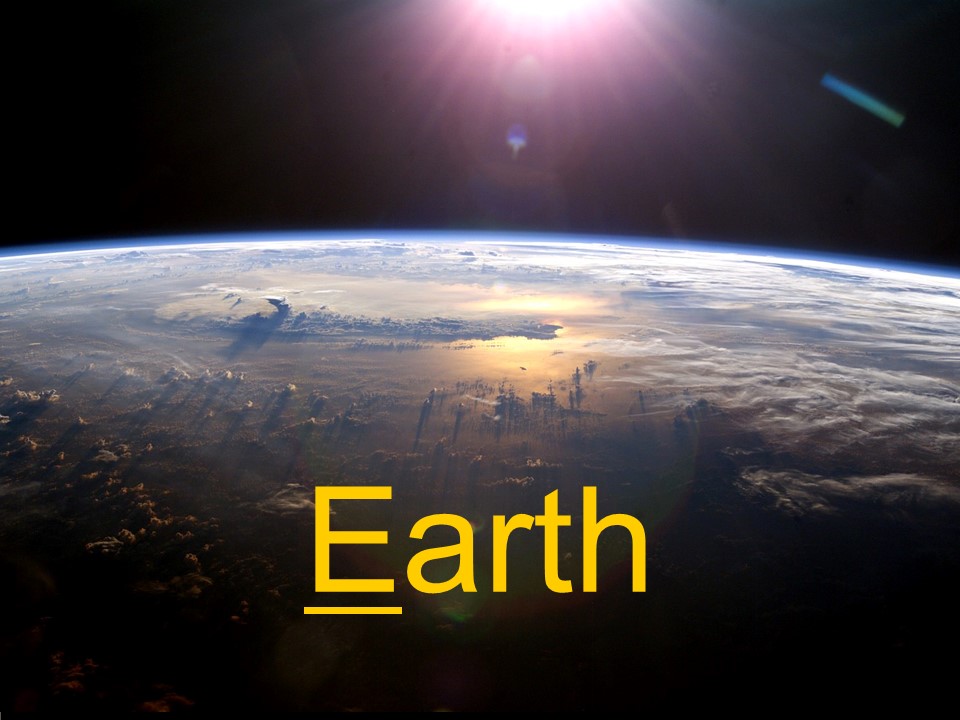
The word, “Earth,” when referring to our planet, should be capitalized. It’s the official/correct way to write it – see Dictionary.com or any other source. Thus, it’s long intrigued me, that while names of other planets are always capitalized, our own planet, Earth, is very commonly written as earth. Don’t take my word for it; check it out yourself. You’ll never see “mars” or “jupiter” but “earth” is liberally sprinkled throughout the written word!
Dictionary.com even states that “It is acceptable [my emphasis] to leave earth lowercase and use the with earth if you are talking about it as the planet we live on: The earth rotates on its axis.”
Consider an amusing on-line response to this odd inconsistency:
“To Mr. Pedantic, and all who live on Earth, I believe that there is no proper context for calling our planet “The Earth”. You claim: “Earth” is an entity; “the earth/the Earth” is a planet.” I disagree. “Earth” is the name of our planet. You’ve never in your life heard anyone refer to “The Mars” . . . To get personal, my name is Max. I’ve never been called The Max. I have however, on occasion, taken it to the max. But that’s different.” (http://www.english-test.net/forum/ftopic13545.html)
This may be entertaining, but how we value things through our language is subtly serious and profound. We denote importance and respect, for instance, through capitalization of “proper names.” If we write “jackson spoke at the kiwanis club meeting on thursday,” we disrespect Mr. Jackson, the Kiwanis Club and even the God Thor. (Word processing programs don’t even allow one to write these words out in un-capitalized form – they automatically change jackson to Jackson at first, and then underline jackson in red if you override the proper form.) And yet, if you write “earth is the 3rd planet in the solar system,” on the computer it’s perfectly acceptable to both word (oops, I mean “Word”) and to society!
Many would dismiss these inconsistencies with “well, I see your point, but it’s not that big a deal.” Indeed, it’s not a big deal in and of itself, and I’ll never go on a campaign to publicly shame those who write Earth incorrectly as earth! However, I do think that the casual decapitalization of our planet is just one example of the equally casual dismissal of our profound relationship to our planet. For instance, the ubiquitous view of almost all of our ancestors – that Earth is alive and that we are a part of that life – is masked and swept aside by our referring to our planet as the “3rd rock from the Sun” and even immortalizing this as a TV show! Or, consider how we might describe something as boring or uninteresting by calling it “mundane” – a word that derives from “Mundo,” the Latin word for “world.” Through our language, we unconsciously disrespect and ignore the life upon which we depend!
We all casually use language that we’ve inherited and learn from a young age. However, by taking a closer look at our language and making some conscious changes, we could help set the stage for new and needed sensibilities. An easy place to start would be to simply follow existing spelling rules and capitalize “Earth.” Then, we could break the rules and extend honor to other words that are not capitalized under current convention: words like: Nature, Human Being, Universe, Life, the four directions (North, South, East and West), and the four seasons (Spring, Summer, Fall and Winter). When we speed past these words in their un-capitalized form, we miss their fundamental role in our relationship to Life!
Next on the list might be to find alternatives to phrases that cause us to subconsciously separate ourselves from Life as a whole. Phrases such as “getting out into nature,” and “man-made or natural,” for instance, imply that indoor settings and human-made substances are not part of nature. In what ways might we convey the importance of getting outdoors while preserving the understanding that by going indoors we don’t somehow leave Nature? How could our use of language help us re-discover, for instance, that Human-made substances are as perfectly “Natural” as bee’s honey or rattlesnake poison? This perspective would yield a new sense of responsibility based on whether something is healthy or not rather than whether it is “natural.”
Perhaps as we consciously make such changes – or at least pay close attention to our present usage – we might come to appreciate something like the following paragraph:
“We Human Beings are the conscious creativity of a Living Earth from which we arose. We are reminded that we are a seamless continuum of Life by metaphors such as “Erda,” the Germanic Goddess of Earth (from whom our planet’s name derives) and other mythic concepts and personifications, such as Terra, Gaia, Jord and the nameless Tao. As science rediscovers what our ancestors knew mythically and through experience, the boundaries of our understanding of Human Nature are redrawn and expanded. These expanded boundaries free us to create alternatives to the destructive stories that order our existence and create meaning today. We can’t transcend Human Nature, but we can come to see that that our Human Nature is part of Nature as a whole and honor that relationship. Answers to our challenges will emerge as new stories expand to fill these new spaces. It’s our conscious Human choice, our conscious Human responsibility to create new possibilities.”
All of this deeper inquiry might start by simply Re-capitalizing Earth!